Suspense and Secrets : The Double Life in Contemporary Fiction

The ‘double life’ or secret identity is a recurring theme in contemporary fiction. Characters conceal their true selves or roles, leading to complex relationships and suspenseful narratives. 

Contemporary fiction borrows themes and tropes from the classics. In Oscar Wilde’s The Picture of Dorian Gray, a portrait serves as a visual representation of Dorian’s double life and the consequences of his choices.

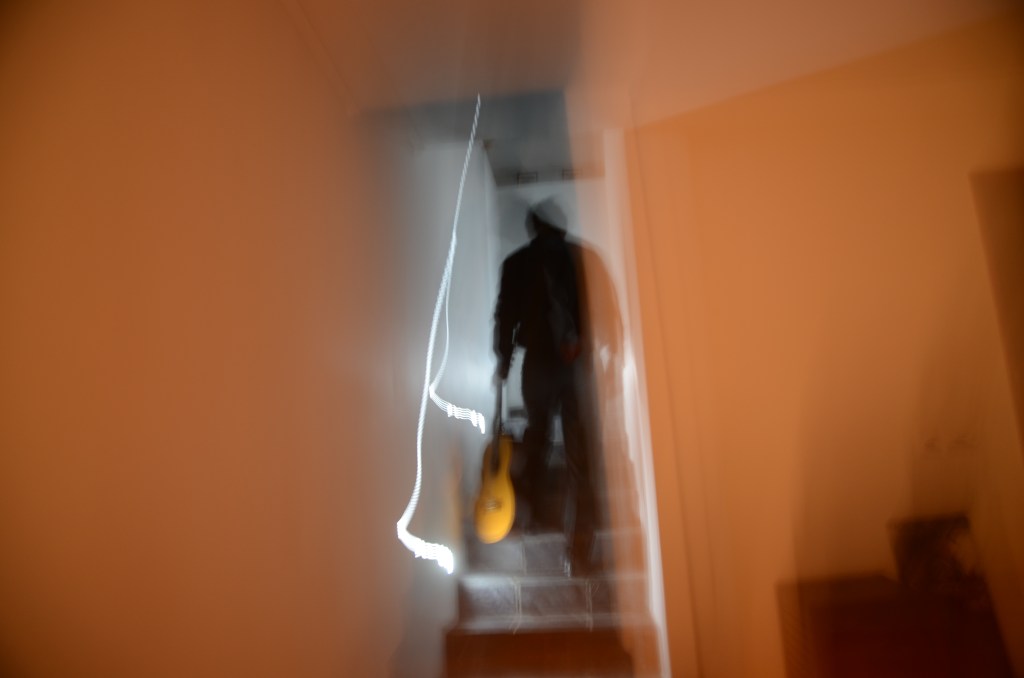
Whenever I needed to get inside my reluctant 3rd-generation funeral director’s head I’d walk around the atmospheric fishing village of Kalk Bay.  On that winter’s night, through an altered reality crack, I ‘saw’ a man back from a late night guitar gig, staring into a mirror at his dandruff, not able to see any escape from the burden of the past. The following day I wrote a short story about an undertaker called Anthony Loxton, who secretly liked hats and guitars, and led a double life, until his two lives collided.

I write contemporary suspense fiction about apparently normal people with a hidden double life. And in the way of the best suspense fiction there is always a love dilemma at the centre of the mystery.

A boy sleeps in a coffin and plans his escape from the family business funeral parlour. How does one escape one’s own family history? Lily the redhead is an unlikely catalyst for change, but adult Anthony surprises himself by breaking his own rules.

A woman enters a world of sexual and emotional abandon in order to find her lost husband. Paola Dante is ambitious, not the sentimental or motherly type, but the universe has other ideas. Daniel de Luc is the mystery man on the station platform she fell in love with a long time ago. Along the way, as she follows the mystery of her determinedly awol soul mate, she finds a daughter but things are complicated. 

The people in my novels exist on the border between real and unreal.

They confront talismanic forces as they walk a tightrope between their everyday lives and another plane of existence where forbidden secrets are currency.

We all have secrets. Some are more forbidden than others.

(Author photos credit for this blog on location in Kalk Bay, Bernadine Jones)


Corona, the Baker and the Snail

Books In The Time of Corona
Eroticism and Suspense in the time of Corona

I confess that I tried to make a sour dough starter and failed.

Before. Lockdown Level 5. My niece passes on the idea and sends a video link. I watch a charismatic and patient young London baker explain his life’s passion. During. I spend two weeks feeding (too sporadically?) my ravenous potential-loaf-of-bread child. It doesn’t rise a centimetre. I give up. After. There is no incredible sourdough loaf. Maybe another time.

I’ve come to think of things in terms of the before, the during and the after. It’s surprising what stays with you.

When I see the BBC link to readers’ photographs with the theme of ‘paths’ I pause, measuring whether scanning great images is a good way to utilise my permitted 30 minutes of daylight online browsing during the time of self-isolation.

Before. I wonder briefly what the photographs will capture in the time of Corona. A photograph of a group on the Otter Hiking Trail won’t do anymore. Entry to national parks of all types is forbidden in many countries. Beaches are also forbidden. I hear on the news that Australia surfers are allowed to surf but not to tarry. My mind goes down side roads. Does a surveillance drone leave traces of its path in the air? I think that should be recorded by somebody in a photograph. We fixed up our fishpond just in time. Our koi Eugene, a terrible pale monster, knocks the smaller fish aside and gobbles up all the pellets. Could I capture his scything water path?

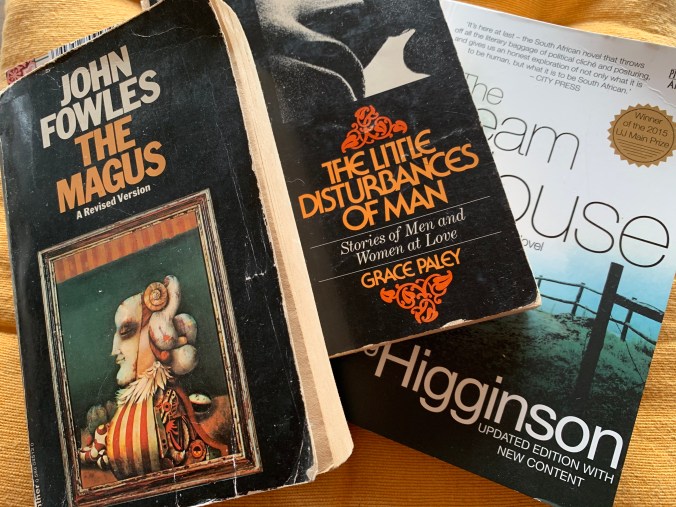
The ‘before’ part is over quickly in this case. The ‘during’ part is a couple of clicks away. I’m too late to send photographs this time round. I’ve missed this theme. They might not  accept a photo from a non−UK citizen, even though it’s a time of global outreach and hands stretched across balconies from Moscow to Bogota. Globalisation is complicated. The theme of ‘reading’ happened a while ago. I hope they’ll bring it back. I have lots of possible photos for that… The one I took yesterday shows a sawed off cat (the cat jungle gym effect) with Grace Paley’s The Little Disturbances of Men carefully positioned above his head.

Lockdown feels a lot like reading in a purple bedroom or under a pear tree or perched on a waste paper mountain. There is escape in the solitude. The Magus is being re−read. John Fowles, you are my Corona life-saver, I am reminded that nobody writes eroticism and suspense like you do. I am grateful that in the foreword you insist that none of it is as effortless or as plotted as it seems and that in fact it is the result of copious rewriting and you were never quite sure yourself what it was about or why the story had such wide appeal. You make it possible for the rest of us to continue putting words down. How do I hold the ‘during’ for longer? How do I make myself remember The Magus with all its enigmatic sorcery? It seems important, somehow, that I should remember its lessons – both literary and philosophical − better.

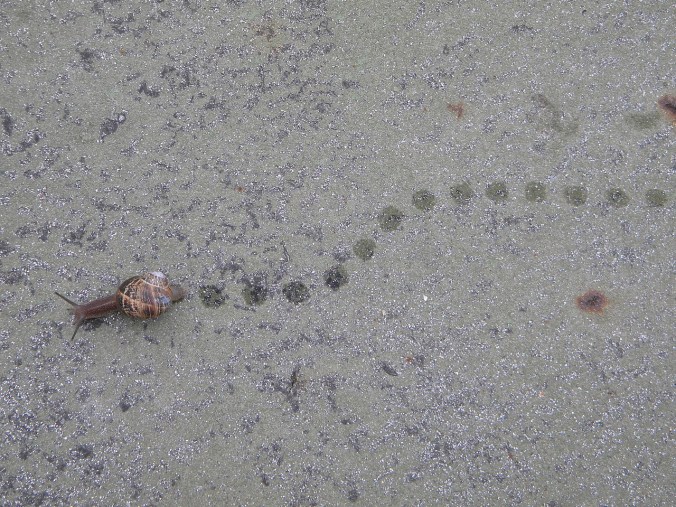
Back to the snail. Days later I get to the ‘after’ part. A photo taken in natural light of a little pearlescent land snail making its own path on another path (perspective is all) has something about it – the other images, some amazing ones, all with a lonely feel, have become the background.  The small mucus path, each contraction of the muscular foot placing a print as it glides forward, roughly mirrors the geometry of the larger stone paving and cement joint configuration. The photographer captures the graph it draws, which is not flattening, and the precise moment its sovereign house casts a bulbous shadow. See the photograph here: https://www.bbc.com/news/in-pictures-51400405

It has something of  ‘A Small Good Thing’, Raymond Carver’s indelible short story.  There is something big about the tiny modest life form that gropes at one. It’s all there in that image of the snail, taken in early February: connection, helplessness, loss, conflict, communication, isolation and loneliness. In the snail’s case nothing bad has happened – yet.

Beauty in small, good things. The simple daily routine. Waking up pre dawn to do the work of life. The Baker and the Snail.

Corona has isolated me and yet technology makes me feel more part of the collective than before. Nature is returning. The birds are flying and the ants are building a city beneath our driveway. The draft for book III of the Limbo trilogy is being brought to completion. I imagine that snail turning back often as it wonders if it has missed something important, a succulent green leaf or a shy fellow snail… Snails are known to suffer stress from loneliness.

Eventually the mucus footprints will tell a story, however many times they double back. There will be a beginning, a middle and an end. A good story has its own logic. It’s a strange thing when one looks at it – how the imagination blooms in isolation. It seems perfectly understandable to me right now why Emily Dickinson simplified her life so that she might live within the possibility of the imagination or why Mark Twain in his garden study instructed his family to blow a horn if they needed him.

The horn idea appeals to me. The full extent of the ‘after’ stage is not yet known.

PS. This is another little snail in another image.

La Stanza – The Room

Sils_Maria_thumb_67ff

How queer it is to be moved by a room. It happened to me in Sils-Maria, a place I now carry with me. I stood on the doorsill of the cordoned-off restricted space where a man of great intellect had sat at a small desk – the original piece of furniture still there – and pondered the human condition by lamp light. He had rented this room in a private boarding house in a remote village in the Swiss alps, hoping the mountains with their pure glacier air would act as a restorative. I imagined him breathing in deeply as he opened the small window, letting his gaze rest on the stoic grandeur of the scenery, contemplating the path of his first walk when daylight faded.

Some of his copious notes and manuscripts were displayed downstairs: his philosophical stance was controversial − God is dead. For a long time his name evoked the excesses of fascism and Nazism but dedicated scholars continued to engage with his work as philosopher, cultural critic, Latin and Greek scholar, and artist. Today German philosopher Friedrich Nietzsche is generally viewed as having exerted a profound influence on Western culture and modern intellectualism.

That holiday room, where he spent so many hours ruminating and writing, making palpable ink marks on paper as he held poor health and incipient madness at bay, moved me. Not as a student of philosophy or as an admirer of his intellectual prowess but as a writer. It frightened me to know that at the age of 44 he succumbed to mental illness, . His modest upstairs room came last in the museum tour. You came to it after studying the well-lit writings and photographs and mementoes, on walls and in display cabinets, of other great thinkers and writers whose lives had intersected with his. The Jewish doctor and scholar who believed Nietzsche’s ideas had been misappropriated and devoted his writing to bringing the philosopher’s legacy to public attention. The Italian Swiss poet Remo Fasani who wrote exquisite lines in Italian that pre-empted any attempt of mine to distil that room and its emanation into something true.

We’d come to visit Sils-Maria after I’d overheard snatches of a conversation between a German lawyer who knew the area well and a Canadian girl in my ski school group. Sils-Maria. You cannot come to St Moritz and not go to Sils-Maria. My skin had prickled at the older woman’s hushed tone; she spoke as people do when a place is special, its effect not quite explainable, as when one has had some kind of a spiritual awakening.

And she was not wrong. It cast a spell over us, its visitors, from the moment we left our car on the outskirts and wandered into the radius of its strange magnetism. It was an entrancing place in the frosty light of late afternoon with its majestic mountains,  in the distance a flat plain with solitary trees on the edge of a lake, the wintry sun an incandescent fireball trailing pale golden light across the horizon and onto the shimmering surface as walkers roamed its shores. We walked into the picturesque village and peered into garlanded shop windows, the dream landscape enveloping us, feeling as if we’d stepped into a Christmas snow globe. A local pointed us in the direction of the best bakery and coffee shop in town.

The woman behind the coffee shop counter considered my question, eyed the soft toy husky puppy in my hands, thought a little, tried a name out as she looked at it, shook her head, and then said in decent English, “Olaf. Yes, Olaf. Maybe that is a good name?” I tried it out, holding the furry toy in my hand and looking into its arctic blue baby dog eyes. I’d expected Swiss but I’d gotten Russian. Olaf. It was perfect. I explained it was a gift for my nephew in South Africa. She smiled, popped it into a bag, and processed my credit card. The coffee and cake was excellent.

That’s the kind of town it was. It made you feel as if you’d stepped into a magical fault line where a perfect place existed, but the moment you drove away, or acted outside of some unwritten set of laws regarding what it meant to be a civilised human, then it would no longer exist. Then all that remained would be a thick white fog where ghosts roamed unhampered by visitors, and you’d never find it again.

Refreshed, we donned thick jackets once again and headed for the impassable striated mountains just beyond the town, under a traffic boom, past converted luxury apartment blocks in the shadow of the town’s only ski lift, past traditional homes with curious paintings on their walls and grand old-time hotels, past an avant-garde glass barn house on a flat open field its relaxed occupants clearly visible, past the town library with its carved wooden totems.

The soft falling snow grew denser. Horse carriages with passengers passed us in the gloam, the clip-clop of trotting hooves echoing eerily as they disappeared into whiteness. Realising we’d lost track of time we hurried back to the Nietzsche-Haus museum we’d seen on our way in. As we approached the tall narrow house, dusk settling around us in descending ruffles of pluming darkness, we saw lamps had been lit in some rooms and ceiling lights illuminated others. It was set a little back from the road with a long straight path and stairs that went up to an entrance porch. The front door opened as we reached it and a young Japanese couple slipped out as we slipped in.

Friederich_Nietzsche-508x640_Edvard Munch

Portrait of Friedrich Nietzsche by Edvard Munch, 1906

P.S. It is widely believed that Nietzsche’s final descent into the darkness of dementia was triggered by an act of cruelty to an animal. In 1889 Nietzsche witnessed a horse being whipped within an inch of its life by a coach driver in Turin. He rushed to the horse’s aid, embracing it and refusing to let go, and the police had to be called. I didn’t know about the Turin horse when I stood on the sill of that humble and sombre room, but somehow it seems apt.
High as a kite

Today I reached the end of School Side Road and a madwoman was yelling at a figment hiding in a tree. I slowed to a walk and went right up to the tree and peered into the electric-green leafy boughs (given that we’re in the midst of a drought this seemed odd) and there was no one there, at least nobody that was present in the way she and I were. She eyed me suspiciously, her filthy headscarf pitched at a perilous angle, but then continued with her diatribe in street Afrikaans, haranguing an unseen partner, possibly dead, but perhaps passed out just around the corner in a shady spot. “Jy’t my gedonder … Jou bliksem… maar ek … roep vir security, en hulle kom onmiddelik … klap!… Jy gaan sien!” All the way back to busy Old Kendal Road her presence followed me, high as a kite, invoking the forces of law and order upon the unseen entity’s head as she careened around that tree.

It was the turnaround point for that day’s circular route so the small event had come just in time. Some Run/Walk club days when I’m out on the road, jogging the kilometres away in silence, nothing interesting happens but it’s rare. Usually something does.

To run is to leave the body and then return to it, a little surprised to find one’s physical body still stepping out to some ancient rhythm, still anchored by earth’s gravity. To walk is to pause and pay attention. To write is to imagine. The sighting of a homeless woman wailing fulminations up into a hapless tree makes me laugh and then it makes me serious. We live on the same planet and yet we dream in different galaxies. Who knows how she will re-appear on some distant day, which fictional character she will inhabit and inform, which new life she will live? I can present her with choices she never had. If I write her right upon the page she can wrench the same hearts that walk past her heartlessly every waking day.

I ask myself “What is the meaning of this post?” Eventually, beneath layers and layers, the snake of knowledge lies coiled and waiting for me; across the divide of class and culture the madwoman and I have things in common: born female in Africa, a dread of emptiness, an inexplicable urge to challenge deaf gods, a liking for eccentric headgear. Something subtle and paradoxical has drawn me into her scene as surely as if it were from a famous play with important themes, performed by a world-renowned actor.

The Undercover Soundtrack | Roz Morris – Consuelo Roland’s LADY LIMBO

‘Skinny-dipping in greenish-hued waters’

Once a week I host a writer who uses music as part of their creative environment – perhaps to connect with a character, populate a mysterious place, or hold a moment still to explore its depths. This week my guest is award-nominated novelist, poet and essayist Consuelo Roland @ConsueloRoland

Soundtrack by R.E.M., The Beatles, Lawrence Ferlinghetti, Youssou N’Dour, Bob Marley
___________________________

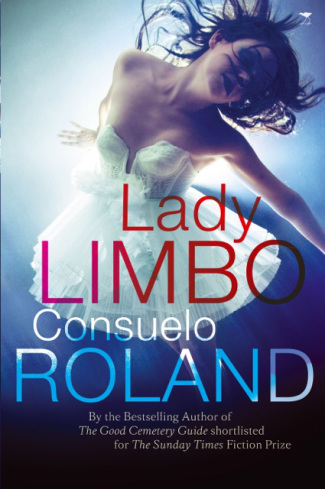
Lady Limbo began with a cancelled flight and a personal tale of sexual liberation imparted to my mother at Charles de Gaulle Airport.

The details of a mysterious organization reside in a little black book belonging to a helpful ground hostess whose name is forever lost in the torrential downpour of a stormy Paris night. It was fun to turn things around and evoke a world where men are paid ridiculous stud fees to be at the beck and call of willful women who can afford to be extravagant. Occasionally a perfectly ordinary, independently minded woman – such as a sexy ground hostess – will use their services.

From a little black book to a husband that vanishes into thin air is not such a literary leap of the imagination. The only tangible clues to the ‘disappeared properly’ man’s identity are the vinyl long playing records (LPs) carted into his current incarnation: Daniel de Luc, husband.

A man who favours alternative rock, old circus music (think extravagant carnivalesque LP cover art),and African jazz, is perhaps not going to be your average conventional spouse.

A voice for intensity

When Daniel de Luc barges into my novel with all his unpredictable here-now-gone-tomorrow energy he arrives together with cult band R.E.M. Their music is constantly playing in my car. The wickedly intelligent lyrics have the enigmatic aura of a Poe story.

– Consuelo Roland

KEEP READING
__________________________________


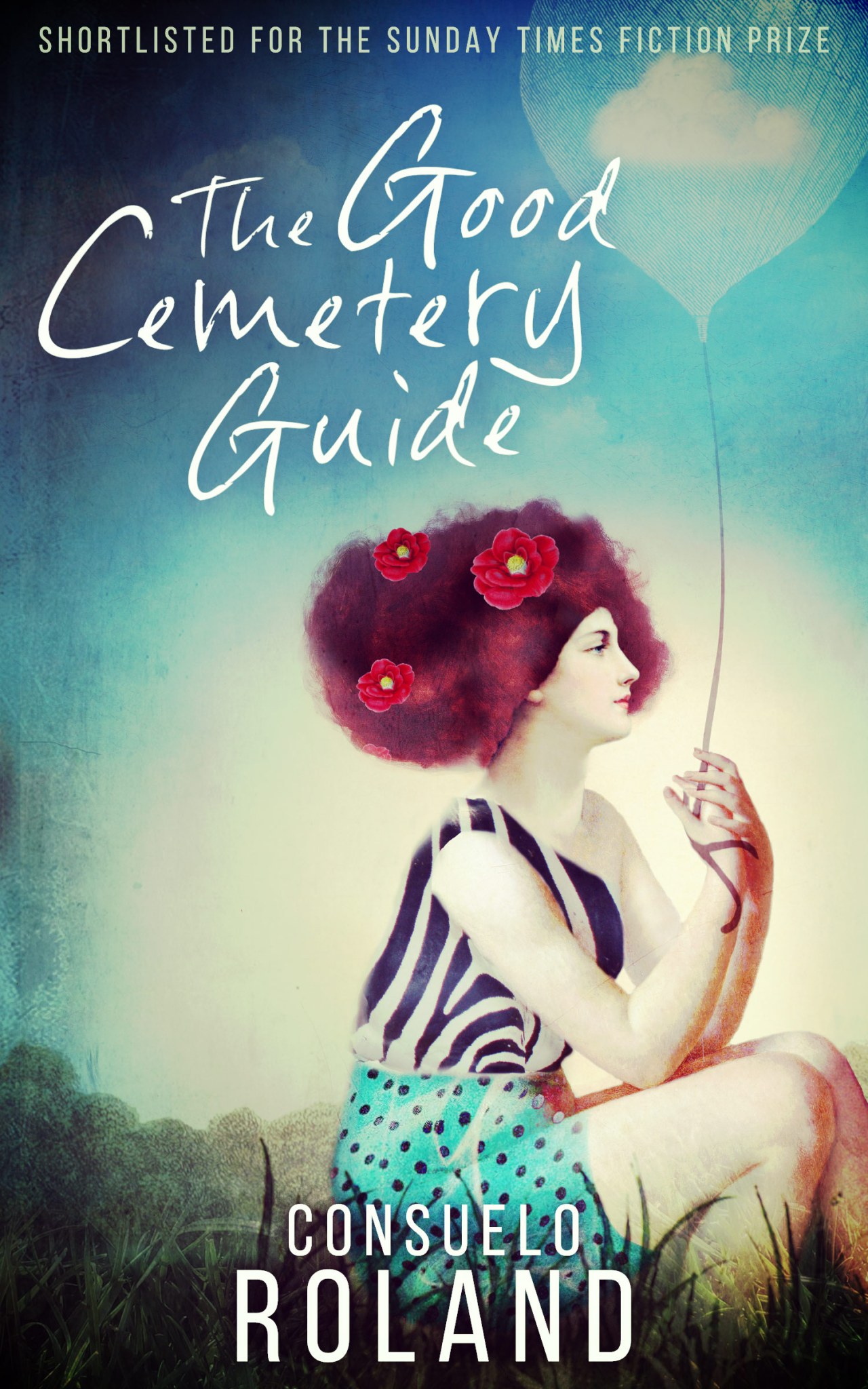
A new cover for The Good Cemetery Guide

This latest e-book cover version arrived quietly,  over time… As small good things do. 

eCover-GoodCemetery-22Nov2016version2a_FINALWhat can I say? I suffer from book cover OCD. It explains everything. The long hours, the diversions, the steep learning curve as I hunted the right image and then the right cover design down…

Evocative cover art attracts me as a kingfisher might spot the glinting scales of a fish about to surface from far off.

Gazing and appreciating is a long way off coming up with a good cover for your own story.

Lesson 1 Learnt: Setting out to find the ultimate cover yourself is a time and energy draining exercise. I experimented with and discarded so many covers and so much good advice – it’s certainly not fashionably minimalistic with a punchy simplicity. Something felt right about this one.

When I first saw the Zebra stripes girl I had a feeling of deja vu, as if Lily, the unintentional cause of a small town funeral director’s life taking an unexpected turn, had somehow stepped out of fiction into life. There she sat, dreaming and remembering and contemplating the future in her quirky outfit, inhabiting an artwork done by a faraway artist who had not read my novel. My nocturnal visitation – the haunting impression of a striking big-boned redhead hovering, trembling with nervousness, waiting near the stage for Anthony Loxton to finish his guitar gig in a dimly lit music bar – plucked from the ether. The balloon was a bonus.

Lesson 2 Learnt: Be persistent and have faith in your own visual acuity. The font I really liked for the title turned out to be problematic – the letters weren’t sharp enough making it look hand drawn and unclear. Eventually after we’d both searched through hundreds and hundreds of fonts my cover designer came up with the existing font, which had the chalk writing look but was still legible even in thumbnail size. It wasn’t a popular font on any of the “best e-book covers” websites I checked out but nothing else looked right so I went with it.

Lesson 3 Learnt: Here’s the biggie – the truth is that just because you love a certain picture doesn’t mean it will easily transform into a book cover. The position of the daydreaming woman had to be adjusted to the right for the title to fit, and the colour hues had to be tweaked with variations so that it was lightened but the white text still stood out, and then more shifting and more colour hue adjustment went on so that the all-important balloon (as per the storyline) didn’t disappear into a lightened background. Using your own mind can be time-consuming and costly. It’s definitely a good idea to get your cover designer’s input on the matter before purchasing the artwork.


And then there were three (NYNs)… Do you find plot more difficult than character? | Roz Morris

 Nail Your Novel

SONY DSCPhew, the plot book is ready. It seems to have taken a marathon of effort; much longer than the characters book. So much that I’m wondering if this tells me something about the nature of plot.

In writing the book, I’ve been pinning down the ultimate essentials – what a plot is, what it needs – whether you’re a genre author, a literary author, or anywhere on the spectrum between the two. Indeed, if you want to defy convention, are there some story and plot principles that still hold? I found there were. I also found that even an apparently loosely structured book followed a few simple patterns.

But honestly, Roz, you’ve been promising this book for most of the year.

Yeah, why did it take me so much longer than characters? As I wrote up the tutorials – starting from blogposts and mentoring notes – I found that each…

View original post 919 more words

Joyce Carol Oates: ‘People think I write quickly, but I actually don’t’ | Books | The Guardian

The books interview: The prolific author on the unreality of romance, the fickle memory of Americans and how tweeting has got her into trouble.

When Joyce Carol Oates, the 77-year-old author of well over 100 books, told the New Yorker last year that she thought of herself as “transparent”, before adding “I’m not sure I really have a personality”, the admission felt scandalous. We live in a time when the concept of personhood has been enshrined, in the monetising parlance of late capitalism, as “my personal brand”. To posit its non-existence is a kind of taboo. Especially if you happen to be someone often described as “America’s foremost woman of letters”.

Oates, a five-time Pulitzer finalist, might be “very intensely interested in a portrait of America”, but clearly she has no truck with the ego-vaunting, personality driven paradigm of contemporary celebrity. She appears more to belong to some other, long-passed era, with a pronounced gothic streak colouring much of her fiction, which tends to be peopled by powerful men and introverted women who frequently experience sexual shame. In the afterword to her 1994 collection Haunted: Tales of the Grotesque, she seems to find a human truth within horror: “We should sense immediately, in the presence of the grotesque, that it is both ‘real’ and ‘unreal’ simultaneously, as states of mind are real enough – emotions, moods, shifting obsessions, beliefs – though immeasurable. The subjectivity that is the essence of the human is also the mystery that divides us irrevocably from one another.”

At her home in rural New Jersey she serves mugs of herbal tea and when her bengal kitten, Cleopatra, settles against my leg, Oates says: “I see you have quite a conquest there. She assumes you’re here to meet her.”

KEEP READING

And then there were three (NYNs)… Do you find plot more difficult than character? | Roz Morris (original – sent to wordpress from blog)

Roz Morris @Roz_Morris's avatarNail Your Novel

SONY DSCPhew, the plot book is ready. It seems to have taken a marathon of effort; much longer than the characters book. So much that I’m wondering if this tells me something about the nature of plot.

In writing the book, I’ve been pinning down the ultimate essentials – what a plot is, what it needs – whether you’re a genre author, a literary author, or anywhere on the spectrum between the two. Indeed, if you want to defy convention, are there some story and plot principles that still hold? I found there were. I also found that even an apparently loosely structured book followed a few simple patterns.

But honestly, Roz, you’ve been promising this book for most of the year.

Yeah, why did it take me so much longer than characters? As I wrote up the tutorials – starting from blogposts and mentoring notes – I found that each…

View original post 919 more words