The Realm of Fascination is a knowledge base for The Good Cemetery guide. Learn more about what inspired the book:
AUTHOR | THE BOOK | RITES | DIGITAL | ART | BOOKS | GALLERY | ABOUT KALK BAY | ABOUT MEXICO
What is a man’s destiny?
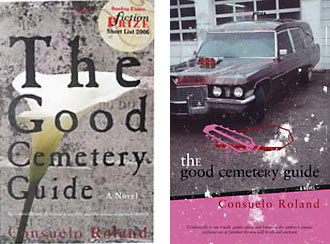
THE GOOD CEMETERY GUIDE is set against the background of Anthony Loxton’s lonely childhood.
Anthony lives in Kalk Bay, a small seaside town, with his mother, Ma, and fulfils his role as the third-generation funeral director at the Loxton Funeral Parlour. Events unfold on a daily basis, drawing together the living and the dead in unexpected ways. Facing the prospect of a bleak dutiful future, he conducts a secret parallel existence as Tony the Fox, louche guitarist who plays at a local music bar and has brief unsatisfactory liaisons with women who frequent the locale.
When a nubile one-night-stand (Lily) makes a dramatic appearance in a body bag at the funeral parlour his two worlds collide. Anthony breaks the cardinal unspoken rule of the funeral business by getting ‘involved’ in the last stage of Lily’s life, knowing that nothing can ever be the same again.
“Once upon a time there lived a man who was born the son of a mortician. In this small matter of the choice of a suitable father no choice was given to him. This at least is true of every man. No man chooses his father.” – THE GOOD CEMETERY GUIDE
Can redemption be achieved through love and friendship?
In THE GOOD CEMETERY GUIDE the feisty clear-sighted Grethe and frail catankerous Ma are key figures in Anthony’s life. Through the intervention of a cast of eccentric characters, including Sweet his childhood mentor who punishes his book-stealing habits in an unusual manner, Miss Sophia who is more stealthy and dangerous than she looks, the seductive photographer Alexandra (aka Akauba) whose passion is the art of death, Aurora Morningstar, double-jointed spiritual advisor who likes him just as he is, and a lucky mascot Mexican skeleton paper puppet who dispenses random good advice with gay abandon, Anthony comes to the realisation that his efforts to beautify the old town cemetery are more significant to his future fulfilment than he had supposed.
“‘It’s up to you,’ the Mexican skeleton says, ‘just keep going, one foot in front of the other, follow your heart, maybe it’s not too late for you, maybe you can come back from the dead as an undertaker!’ He holds his sides in a paroxysm of laughter, his bones rattling in spasms of mirth until all at once the string breaks and the body parts fall to the floor like paper rain. ‘Nothing is permanent,’ the skeleton cackles, ‘just put me back together again and I’ll be good as new.'” – THE GOOD CEMETERY GUIDE
“…O God, Thy sea is so great and my boat is so small…”
THE GOOD CEMETERY GUIDE is a work of fiction. Any resemblance to actual persons, living or dead, is entirely coincidental. The Kalk Bay in THE GOOD CEMETERY GUIDE, though created out of the ether of a real fishing village with a railway at the edge of the sea, is a town of fable.
“…only the railway stands resolute and solid in front of him, two straight tracks heading out of town. When he looks left he sees the wide white beaches of Muizenberg stretching into the far away, and when he looks right he sees distant mansions against the hillsides that line the bay. It is a seesaw with Kalk Bay at the centre of the universe. There might as well be wild wolves beyond the frontiers, he wouldn’t know.” – THE GOOD CEMETERY GUIDE
And what of the resonant echoes of live music?
Eye-catching posters are visible throughout Kalk Bay, advertising night-time venues where dedicated musicians ply their trade, paying their dues, drenched in sweat under glaring floodlights on small wooden stages. It was in one of these dimly-lit unassuming passion-charged venues that we listened to Steve Newman, Tony Cox and Syd Kitchen, all consummate home-grown South African guitarists, before driving home through a thick soup of salt-laden mist past a road-side funeral parlour in another town further on that coastal road. Out of that post-midnight sea-fog an undertaker who played guitar to escape his dull existence appeared, and it seemed natural that Anthony Loxton, mortician extraordinaire, would live in Kalk Bay.
With the boat stopped the son empties the urn overboard, the ashes lying on top of the icy calm water, swirling into irregular lengthening shadows that eventually break up and disperse. Gus reads a poem about his father being the master of his fate, the captain of his soul. He can’t be serious. Life’s a runaway fire.” – THE GOOD CEMETERY GUIDE
The Philosophy
“He goes out to talk to them, to plead with them, talking about dignity and consideration and everybody’s right to a decent burial attended by family and friends (he leaves out ‘associates’ which seems inappropriate, although he clearly remembers the grandmother’s singsong instructions via the nephew). He is not here to judge what is goodness or how much goodness is enough or not enough. He sounds pompous and ridiculous in his own ears, and yet he is sincere. The mothers of MAGAD are incensed. They pelt him with rubbish. In the face of the mediaeval justice being meted out to him he retreats, still facing them but now speechless, and miscalculates the position of the steps behind him. The police arrive, having received ma’s hysterical phone call, and an ambulance gets there just afterwards to take him off to hospital to be checked for shock and concussion. The ambulance men manhandle him, eager to bundle him onto a stretcher and turn him into a patient. He has blood pouring from a gash on his face where he hit the Loxton Funeral Parlour front steps as he fell, but he refuses to go. Admitting only to himself that the biggest shock is his own bruised ego. “
THE GOOD CEMETERY GUIDE
Death is the backing on the mirror that allows us to see anything at all. – Saul Bellow
 Consuelo Roland