The ‘double life’ or secret identity is a recurring theme in contemporary fiction. Characters conceal their true selves or roles, leading to complex relationships and suspenseful narratives.
Contemporary fiction borrows themes and tropes from the classics. In Oscar Wilde’s The Picture of Dorian Gray, a portrait serves as a visual representation of Dorian’s double life and the consequences of his choices.
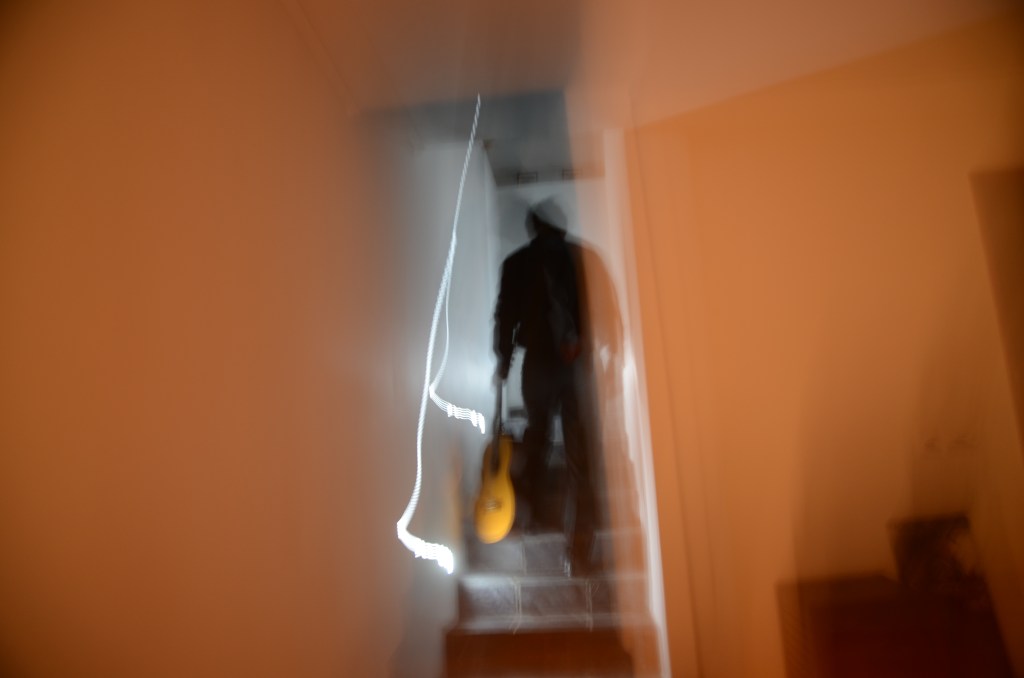
On a winter’s night, after a guitar concert in a smoky locale, a ghostly funeral home appeared out of the sea fog.
Whenever I needed to get inside my reluctant 3rd-generation funeral director’s head I’d walk around the atmospheric fishing village of Kalk Bay. On that winter’s night, through an altered reality crack, I ‘saw’ a man back from a late night guitar gig, staring into a mirror at his dandruff, not able to see any escape from the burden of the past. The following day I wrote a short story about an undertaker called Anthony Loxton, who secretly liked hats and guitars, and led a double life, until his two lives collided.
I write contemporary suspense fiction about apparently normal people with a hidden double life. And in the way of the best suspense fiction there is always a love dilemma at the centre of the mystery.
A boy sleeps in a coffin and plans his escape from the family business funeral parlour. How does one escape one’s own family history? Lily the redhead is an unlikely catalyst for change, but adult Anthony surprises himself by breaking his own rules.
A woman enters a world of sexual and emotional abandon in order to find her lost husband. Paola Dante is ambitious, not the sentimental or motherly type, but the universe has other ideas. Daniel de Luc is the mystery man on the station platform she fell in love with a long time ago. Along the way, as she follows the mystery of her determinedly awol soul mate, she finds a daughter but things are complicated.
The people in my novels exist on the border between real and unreal.
They confront talismanic forces as they walk a tightrope between their everyday lives and another plane of existence where forbidden secrets are currency.
We all have secrets. Some are more forbidden than others.
(Author photos credit for this blog on location in Kalk Bay, Bernadine Jones)
 Departures is the cool name of an astonishingly beautiful Japanese movie (academy award for best foreign-language film) about an out-of-work cellist who ends up working in a funeral home by mistake and proves to have a calling. It makes one think of a Departures lounge at an airport – as if we’re all just in transit from here to somewhere. In the movie the father bequeathes the wonderful idea of stone letters to his young son; he disappears out of the boy’s life but the quaint story remains behind.
 sometimes warm and sometimes cold but always oddly mystical, this nugget of rock created by cosmic activity and ancient weather patterns. Hence the borrowed category title: Stone Letters. The entire significance always seems to escape one: the felt whole is always greater than the sum of words written on the page. Maybe stone letters will work better…
 Consuelo Roland